HAPPINESS IS LIKE A CUR DOG
The Thirty-Year Journey of a Major League Pitcher and Broadcaster
Showing posts with label From the archives. Show all posts

29 December 2009

Forbes Field Photo Gallery


Nellie signs an autograph for a young fan on the field after a game; Nellie pauses during a night game, and a news story about the end of Nellie's career by Pittsburgh sportswriter Les Biederman.

11 December 2009

Labor-Management Relations in the B.C. ("Before Cash") Era of Major League Baseball


In an age when some Major League players earn millions of dollars a season, younger baseball fans know little about the "B.C." era of the game, when players counted themselves lucky to receive $40 a week. Those who played the game in the "Before Cash" era also lacked long-term pension plans or other economic "safety nets" unless they spent more than four years in the Major League.  Nellie was just such a player. Here he recounts his shock upon realizing how little power players had when he attended an MLB Players Association meeting in New York City in the fall of 1956.  


Happiness is Like a Cur Dog makes a great Christmas present for young and not-so-young fans of baseball and anyone who wishes to understand baseball's role in 20th century American history.


An Eye-Opening MLBPA Meeting

After the 1956 season, my wife Bernadette and I returned to Newark, NJ, where I found work at the Newark Star Ledger in the circulation department. In the early fall I received a phone call from Bob Friend, the Pirates’ player representative for the Major League Baseball Players Association (MLBPA). I was informed there was a MLBPA meeting in the offices of Norman Lewis on Park Avenue in Manhattan. Given my proximity to New York, he asked me to attend the meeting for him and take notes. I eagerly accepted.

Park Avenue was virgin territory for me. I was impressed with the tall buildings and luxurious surroundings. I went from being impressed to awed when I entered the offices of J. Norman Lewis, then the player’s representative, and was introduced to the other team representatives–Robin Roberts (Phillies), Sherman Lollar (White Sox)), Bob Nieman (Baltimore), Early Wynn (Cleveland), Roy Sievers (Washington), and others. With a long history in the game, I knew every player in the room. I can’t say they had the same knowledge of me, but it was exciting to be in their company and to be a part of their deliberations.

Robin Roberts, with the aid of Norman Lewis, handled the meeting before a scheduled visit by Commissioner Ford Frick. Lewis informed us that the commissioner could give us only 30 minutes of his time for the meeting, which raised some eyebrows. We wondered what could make him so busy after the World Series and end of the season. Lewis emphasized that we had better use the limited time wisely by choosing a few topics that were of most importance.

After some discussion, we agreed there were two specific subjects we wanted to address. First was the increase in television revenues from the All Star Game and World Series. We desired to have portions of the additional money allocated for funding the players’ pension plan. The second item was to include the wives and children as participants in the health care plan that at the time covered only the players. Sure of our decision, we awaited the commissioner.


Ford Frick arrived on time and was introduced by Norman Lewis to all the players. Following the introductions, Robin Roberts began the meeting by expressing our appreciation for the commissioner taking time to meet with us. Aware of the time limit, he informed Ford Frick there were only two items we want to seriously discuss with him.

Robin was very articulate in expressing our views about the need for additional money to  fund the pension plan given the increase in television rights and advertising revenue. As he turned to Frick for a comment we were surprised to hear the commissioner say, “Well, you know I can’t discuss such a proposal with you. You’ll have to take that up with the Owner’s Pension Fund committee.” That ended further discussion on that topic.

Robin quickly approached the subject of providing health insurance for the wives and children of major league players. Frick shot that down as quickly as he had the pension funding. He stated we would have to take that up with the Owners’ Committee.


Our two discussion items took up less than five minutes of his time, and both were shot down.

The conversation with the commissioner then turned to items so trivial they were embarrassing, but quickly caught the attention of Frick. Bob Nieman informed the commissioner of the background in center field at Baltimore that caused problems for hitters. He said, “There is a house painted in glowing white, located just to the left of center field. When a right-hander is pitching it makes it difficult for batters to pick up the pitch." I noticed the commissioner begin to take notes.

Someone followed with a complaint about the situation in Cleveland: no toilet was available for players in the bullpen. They had to go behind the bullpen, or walk back to the dugout to take care of these bodily functions. Frick continued taking notes.

A similar complaint was made about Kansas City, then a relatively new team in the American League. There was no toilet in the bullpen, but also none in the dugout, so player had to go all the way back into the clubhouse to relieve themselves.

These discussions took up the remainder of the time. The commissioner put the pencil and paper away and before leaving told us how good is was to have a discussion with the Players’ Association. Norman Lewis then escorted Frick out of the office to the elevator. When he returned, his comments were brief but educational. 


“Gentlemen, you have just spent thirty minutes discussing your problems with the most powerful man in the game, the Commissioner of Baseball.” Pausing briefly, shaking his head in disbelief, he continued, “You know what he’s going to do for you? He’s going to change the background in Baltimore for hitters. He’s going to put a toilet in the bull pen in Cleveland and one in the dugout in Kansas City.”

Lewis summed up the futility of our situation, “Gentlemen” he began, “You think you have problems. And you
do have serious problems: Nobody is listening to you!” Baseball then was a paternalistic system. The owners were the parents and we were the children and each party accepted their role.

Eventually, a man with experience, knowledge, fortitude, and a keen understanding of labor management problems became head of the Major League Baseball Players Association. That man was Marvin Miller, who, along with Curt Flood, forever changed the relationship between owners and players. 


Players no longer believe they need someone to take care of them when their career is over. Marvin Miller made them believe they had power. The motto became, “Take care of me now and I’ll be able to take care of myself later.”

07 December 2009

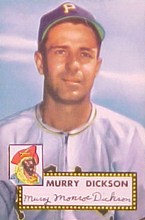
A Clubhouse Comment by Legendary Pitcher Murry Dickson


I was to be discharged from the Army on September 28, 1952. In early September of that year I received a letter from Pirates General Manager Branch Rickey, who, always ahead of the curve in scouting talent, wanted to take a look at the young players from the Pirates farm system that were about to be discharged from service. He asked if I could make it to Ebbets Field when the Pirates would be playing the Dodgers. 


Could I? Hell, I'd walk all the way to Brooklyn if I had to! With two other players on the 60th Regiment team, we drove to Ebbets Field early enough to await the arrival of the Pirates’ team bus.
When it arrived, I introduced myself to Bob Rice, the Pirates’ traveling secretary, and showed him Mr. Rickey's letter. He was unaware of the workout and took me to the clubhouse to meet manager Billy Meyer. Surprisingly, Billy Meyer didn't know anything about the workout either, but told “Doc” Jorgensen, the team trainer, to get me a uniform. I put on a major league uniform and stepped onto a major league field for the first time that day in September 1952 at Ebbets Field.
The only players on the '52 Pirates I had played with in the minors were Frank Thomas, Cal Hogue, and Dick Smith. Before batting practice I got into a “pepper game” and figured one of the coaches would inform me when they wanted me to work out. I heard nothing. As batting practice began I headed out to the outfield to shag fly balls. When the pitchers began to do their running, I thought, “I might as well join them.”
When batting practice ended, I anxiously wondered when someone would take a look at my pitching skills. I went back to the dugout when I noticed the starting pitchers were beginning their warm ups. Having played six years in the minor leagues, I knew I wasn’t going to do any throwing for anyone, so I headed back to the visiting team clubhouse.
The clubhouse radio was on and Red Barber and Vince Scully, who were doing the Dodger broadcast, went over the starting lineups. I began to undress and noticed the only player remaining in the clubhouse was pitcher Murry Dickson (1916-1989), who was then in the twelfth year of a twenty-year major league career. He had tasted champagne with the St. Louis Cardinal Championship teams in the 1940s and won 20 games in 1951 on a Pirates’ team that won only 64 games. He was the only truly qualified major league pitcher on the 1952 Pirates’ team that lost a record 112 games. I had been a huge Cardinal fan as a kid, and to be in the same clubhouse with Murry Dickson was a treasured moment.
Dickson was listening to the broadcast in the fist inning, with two out and Frank Thomas at bat for the Pirates. Thomas hit a low line drive to center field, which Frank thought Duke Snider had caught on the fly, but actually was trapped by Snider. I still recall the description of the play by Red Barber: “Thomas’ line drive was trapped by Snider in center field and he relays it quickly to Jackie Robinson at second base.” Excitedly, Barber continued, “Now Thomas is heading into center field and Robinson is chasing him, and tags him for the final out in shallow center field.”
Dickson, who had seen a lot of ugly baseball that season, said “They ought to send some of these guys so far into the minor leagues that even 'The Sporting News' couldn't reach them.” 


(Image from Gary Bedingfield's website, Baseball in Wartime http://www.baseballinwartime.com)

28 October 2009

From the Archives

Nellie Recalls the Moment the Pirates Won the 1960 World Series


In honor of tonight's first game of the 2009 World Series championship, Nellie recalls a series that the Yankees lost, in the last inning of the last game. Nellie's book is now on sale, and would make a great holiday gift for Pirate fans and baseball aficionados everywhere.

Enjoy this excerpt:

...The 1960 Pirates were a group of experienced, mentally tough, hungry, happy, at times crazy, but always-confident players who felt they owned the final three innings of every game. To the fans and the media, they were the “Battling Bucs.”

Benny Benack’s Dixieland Band created a loose and fun-filled atmosphere at Forbes Field that summer with a theme song written by an advertising agency for Iron City Beer, which had everyone singing, “The Bucs Are Going All the Way, All the Way this Year!” Little did the fans realize that the team’s trademark of coming from behind to miraculously win games would continue all the way to the final inning of the last game of the World Series.

The series was supposed to be a mismatch between the favored New York Yankees and the underestimated Pirates. It was, when you added the total runs scored that the Bucs won all the close games. Prior to the Series, I interviewed a few Pirates’ players, asking whom they thought would be the star of the Series. Groat, Face, Law, Hoak, Clemente, and Virdon were often mentioned. Harvey Haddix, whom I had played baseball with in the Army, was the only player to pick Bill Mazeroski. I asked him why, and with the wisdom of a veteran pitcher he said, “Because the Yankees will pitch to him.”

The Series, which began and ended in Forbes Field, was as dramatic as you could get. The Bucs won the opener 6-4, but were blown out in two straight embarrassing losses, 16-3 and 10-0. Their confidence shaking, the Bucs won the final two in Yankee Stadium with strong pitching from Law, Haddix, and Face, who saved the first three wins.

With the Pirates leading 3-2 in the series, back in Forbes Field for the sixth and, if needed, a seventh game, winning the World Series was now a reality for Pittsburgh fans.

However, Whitey Ford shut out the Bucs 12-0 for the second time, so there would be a seventh game. New York Daily News sportswriter Dick Young best described the situation. His lead line read: “As Mrs. Dionne said to Dr. Dafoe, ‘Don’t go away. There’s more to come’.” (Dr. Dafoe was the name of the doctor who delivered the famed Dionne quintuplets.)


The series now came down to one last game. It was to be the most memorable baseball game ever played in Pittsburgh, and perhaps in World Series, history. Blowing an early 4-0 lead, the Pirates trailed 5-4 following Yogi Berra’s three run homer off ace reliever Elroy Face in the sixth inning. The Yankees appeared to wrap it up with two more homers in the eighth for a 7-4 lead. But there was indeed “more to come.”

Trailing by three, the Pirates’ Gino Cimoli pinch hit for Face and singled to right center. Then the Pirates got a huge break when Virdon’s grounder to Tony Kubek appeared to be a sure double play ball, but the ball took a bad hop on the “alabaster plaster” (as Pirates’ announcer Bob Prince described the rock hard infield at Forbes Field), hitting Kubek in the throat and putting two on and no outs. The blow forced Kubek to leave the game and Joe DeMaestri replaced him at shortstop.

With nobody out, Groat gave one of many of his clutch hits, with a single to drive in Cimoli. Jim Coates replaced Bobby Shantz, who had earlier pitched four scoreless innings. With runners at first and second, Bob Skinner moved Virdon and Groat to third and second with a perfect sacrifice, but Rocky Nelson’s fly ball to right did not allow Virdon to score. With two out and a 7-5 lead, Coates would make the blunder that set the scene for the most exciting finish of a deciding game in the history of the World Series.

Roberto Clemente came to bat and tapped a slow roller down the first base line, which should have been the final out of the inning, but Coates was late covering at first and Clemente, hustling as he always did, was safe. Virdon scored, to cut the Yankees’ lead to one run at 7-6. Hal Smith, who replaced Burgess (who left for a pinch runner in the seventh) hit what then appeared to be the series-winning hit. With the count of 2-2, Smith hit a three run homer to left center that gave the Bucs a 9-7 lead going into the ninth.

Bob Friend, who rarely relieved, was called on to finish the game. Bobby Richardson and pinch hitter Dale Long opened the Yankees’ ninth with singles to put the tying runs on base. With the Yankees’ left-handed power hitters—Maris, Mantle, and Berra—coming up, Murtaugh had no choice but to go with left-handed pitcher Harvey Haddix. Harvey retired Maris on a foul out, but Mantle singled, scoring Richardson to make it 9-8 as Dale Long, the tying run, went to third just ahead of the throw by Clemente with only one out.

Casey Stengel, who had erred in allowing Long to stay in the game, finally realized he needed speed, and Gil McDougald was inserted to pinch run for Long at third base.

In one of the most unusual plays, Berra hit a line drive to Rocky Nelson, who was holding Mantle on at first base. Nelson trapped the ball, tagged first, which took off the force play at second. As Nelson went to throw to second, Mantle, who probably thought the ball was caught on the fly, or made one of the most intelligent running decisions in series history, (I firmly believe it was the former) slid back into first base ahead of Nelson’s tag, as McDougald scored the tying run. I vividly recall watching catcher Hal Smith after this play. His head and shoulders dropped in disbelief. The game was now tied and his three-run homer was just a footnote in the box score. Haddix then retired Bill Skowron to bounce out to end the inning.

Viewing the game from one of the booths overhanging the first base side at Forbes Field, I recall how eerily silent it was, similar to a wake, as the Pirates came to bat in the bottom of the ninth. Bill Mazeroski stepped in to face Ralph Terry, the fifth New York pitcher of the game.

The rest is history. Maz hit what many believe remains the most dramatic home run in baseball history to beat the Yankees 10-9 and capture the 1960 World Series Championship.

How Mazeroski felt during those historic moments remained untold until some forty years later. It came not during a sports interview, but during a post-dinner question and answer session at a Pirates Alumni golf outing at South Hills Country Club in the summer of 2001. An audience member asked Maz to “Walk us through what was going on in your mind at that time.” Maz, in his humble “aw shucks” way, preferred not to respond until everyone, players included, pleaded with him to do so.

Roy McHugh, a prominent sports writer for the Pittsburgh Press in 1960, had witnessed Maz’s home run, and when I told him later about the question asked by a fan at the dinner he remarked, “What a great question! Nobody thought to ask Maz that question before.”

As best as I can recall, this is how Maz described that unforgettable event:

“As a kid living in Rayland, Ohio, I was a big Cleveland Indians fan and hated the Yankees. I remember thinking as we took the field in the top of the ninth inning with a two run lead, ‘here we are, needing only three outs to beat the Yankees to win the World Series.’ However, when the inning began to fall apart and they tied the game I started to think, ‘The damn Yankees always seem to win the big games!’ After the inning ended in a tie, I sat dejected in the Pirates’ dugout, feeling the disappointment of losing the lead, until I heard a coach holler, ‘Maz, grab a bat, you’re the lead off batter in the inning.’

“I had completely forgotten I was the batter to open the bottom of the ninth inning.”

Maz continued his vivid recollection of that moment,

“All I was thinking of was getting a good ball to hit and to hit it hard. The first pitch from Terry was a high fastball that I took for a ball. I remember hearing Johnny Blanchard, who took over the catching duties when Berra moved to left field, holler to Terry, ‘Keep the ball down on this guy. He’s a good high ball hitter!’ The next pitch was another high fastball, but in the strike zone. I knew I hit it good and ran hard, knowing it could be a double and possibly a triple as Berra was going to have trouble fielding the carom off the left center field wall.

"As I approached second base, I noticed the third base umpire raise his hands signaling a home run. That’s when I began celebrating, waving my hat, knowing we had actually beat the Yankees. From the time I reached second base and saw the umpire signal home run, until I touched home plate, my feet never touched the ground.”

The crowd at Forbes Field, along with people working downtown and everywhere in western Pennsylvania, began a spontaneous and amazingly peaceful revelry. To this day, Pirates’ fans who took part in the celebration can tell you where they were and what they were doing when “Maz” hit that home run. Only a year ago a fan told me he was driving on Smithfield Street near Kaufmann’s department store, listening to the game on radio when “Maz” hit the home run. He jumped out of the car, left the motor running, went into a bar across the street and joined in the festivities. Soon the people in the bar moved out into the street with their drinks, joining in the bigger celebration outside. Confetti was now pouring from office buildings downtown; people were driving with their lights on, yelling, and honking their horns.

I was lucky to witness the Pirates’ clubhouse celebration. Players sprayed champagne all over the room as they shared hugs with each other. Bob Skinner and Bill Virdon each grabbed a bottle of champagne and shrewdly hid them in their lockers. ….


02 October 2009

The 1956 Pittsburgh Pirates' Official Team Photograph


Nellie is the tall guy in the middle of the second row from the top. In 1956, Roberto Clemente was the only Black player on the Pirates' team.

The Thirty-Year Journey of a Major League Baseball Pitcher and Broadcaster