Some memories from Nellie's time in the farm teams in the 1950s.
Being tall and thin (6’6”, 180 lbs.) always made me a target for the usual comments — “Don’t drink any cherry soda, you’ll look like a thermometer by the fourth inning!” The most original remark I heard in my eleven seasons of baseball occurred in Macon, Georgia, in 1950. Half a century later, I still can still hear the comment and see the hitter who uttered the remark.
The hitter's name was Phelps, a left-handed hitting outfielder. I went the distance for the win, making up for my less-than-overpowering velocity with control and a good moving sinker. Phelps went 0-4 in the game, and following each out, his frustration and anger grew. In the first at-bat, he grounded out to second base on an outside sinker. From the dugout, I heard him holler, “Is that as hard as you can throw skinny?” The next time up, he popped up to first base. From the dugout, I heard: “How the hell did you ever get into this league throwing that crap?" This line of attack continued after he flied to right field in his third time at bat.
On his final at bat in the ninth, he grounded to first base, and as I covered the bag for the out, I expected to hear his comment up- close. But surprisingly, he quietly returned to the dugout. I thought, "well, okay; he’s done for the day," and was looking in to get the sign from my catcher when I heard Phelps bark out, “You tall skinny sonofabitch! What the hell do you do in the off season — clean the insides of rainspouts?” I laughed like hell, as it was the first and only original comment I’d heard from a “bench jockey.”
In baseball, most of the verbal abuse coming from dugouts or coaches, other than that directed at umpires, is directed at the pitchers. The reason is simple: Pitchers control the flow of the game. If you can break their concentration, you can affect their performance. The baseball term for these vocal pests is “bench jockeys.” To be effective, they need an audience, and pitchers who respond to their taunts become known as “rabbit ears,” since they hear everything.
During my 11-year professional career, I found ample support for my belief that bench jockeys’ vocabularies were equal to their batting averages. After all, why else would they be sitting on the bench, rather than playing? A pitcher’s ability to tune out bench jockeys is always related to the number of years he's spent in the game. When I was 17 and pitching in my first year of semi-pro ball, I listened to one third-base coach ride me constantly. I had rabbit ears, and he knew it. Late in the game, with a runner at third, he suddenly went quiet and then gently asked me, “Hey kid, let me see the ball.” I was about to throw it to him when a veteran teammate loudly informed me that that wouldn't be a wise thing to do....
(Photo: Nellie enjoying the Gulf of Mexico on his last trip to Florida in March 2005)
A new book by journalist Douglas J. Gladstone, A Bitter Cup of Coffee: How the MLB and Players Association Threw 874 Retirees A Curve, tells the story of hundreds of former big-league baseball players who were denied pensions as a result of the failure of both the league and the union to retroactively amend the vesting requirement change that granted instant pension eligibility to ballplayers in 1980.
Prior to that year, ballplayers had to have four years service credit to earn an annuity and medical benefits. Since 1980, however, all they have needed is one day of service credit for health insurance and 43 days of service credit for a pension.
Gladstone began working on this book after interviewing former players about the golden age of baseball. In the course of an interview with Jimmy Qualls, he stumbled upon the story of 847 players who were not included in the pension and benefits plan for former major leaguers. He recalls the moment that this book was conceived:
Admittedly, I never really paid much attention to the business side of baseball. These days, of course, it’s pretty hard to ignore that aspect of the sport. So, last June, when I was interviewing the former Chicago Cub, Jimmy Qualls, for a Baseball Digest story that was ultimately published in September 2009, and he casually mentioned that he wasn’t receiving a pension, being the inquisitive type, I asked him why. When he explained the reasons why he wasn’t, I knew I had the makings of a story that had to be told.
Nellie, who turns 82 today, is among the 847 players who don't receive pensions for their service on the baseball diamond. Gladstone interviewed him last year, and his story is featured in the final chapter of A Bitter Cup of Coffee.
No history of Pirates baseball could be written without lauding Bob Prince, “the Voice of the Pirates,” or, as he was also known, “the Gunner.” No one dominated Pirates baseball more than this larger-than-life Pittsburgh media personality. The son of a career U.S. Army officer, Bob was widely traveled and worldly wise even in his teen years. He studied law, attending Harvard, Oklahoma, and Stanford with limited success, confessing he loved the social scene much more than books. Jack Henry, a Pittsburgh raconteur, described Prince’s college resume best: “Bob Prince’s diploma has more fingerprints on it than Elizabeth Taylor’s ass!”
Everyone will agree that his talents would have been wasted in a courtroom. He was made for radio and baseball. I was fortunate to spend nine years working beside him. Our relationship, like the roller coaster ride at Kennywood Park, was all ups and downs, but never dull.
Prince gave the word “personality” a distinctiveness rarely seen in those days. He wore wild, flashy sports coats and a demeanor to match. You always knew when Bob was in the room. During his broadcasts you had no problem figuring out whether the Pirates were winning or losing. You either loved him or hated him, but you listened. Prince was well aware of the mixed audience response. Once, as he was leaving the press room to begin a broadcast, he shouted out for all to hear, “Gotta go to the radio booth. Twenty thousand listeners are getting ready to turn me off.”
Bob started his Pirates broadcasting career in 1948 under the tutelage of Rosey Rosewell, who began doing Pirate broadcasts in 1936. In those early days, baseball radio broadcasts were not done live since the owners feared fan attendance (and revenues) would drop. How wrong they were; radio broadcasts actually created more fans.
Games were “recreated” in a studio by using the information sent from the site of the game over the Western Union wire ticker tape. By using sound effects--and the listeners’ imaginations--announcers created the illusion of broadcasting the game live from the ballpark.
One of the great advantages of not being at the park was that it gave the announcer the freedom to control the flow of the game by staying a half or a full inning behind the game descriptions coming off the ticker tape. It became obligatory for announcers to fill the slow or dead periods in every game. The good announcers did this by telling stories while still keeping the listener involved in the flow of the game. Rosewell was a wonderful storyteller, on and off the air, and also wrote and published poems.
Bob Prince did not write poetry, but was his equal or better as a storyteller and master of ceremonies....
As the snows of February swirl, anyone who has been involved in major league baseball begins to think not only of opening day--now just two months away--but also of the joys of spending six weeks in the tropics. Nellie and his family treasure glowing memories of splashing in the waves and walking on the beaches of Anna Maria Island on Florida's Gulf coast during spring training, but Nellie also remembers a less pleasant -- but highly educational -- trip to the Pacific coast of Mexico in 1955.
Eager to play winter ball in Mexico, I appreciated my wife’s willingness to join me in my first trip “south of the border.” Neither of us were prepared for the profound cultural differences that awaited us. Making adjustment matters worse was the damage done by a typhoon that hit Mazatlan a week before our arrival. Floods had washed out roads and cut off the electricity. My lack of understanding of the culture and anger about the daily inconveniences created by the storm grew each day. Looking back at this experience, I realized I was an “Ugly American.”
Our trip began with a flight from Newark, NJ to Tucson, AZ. We traveled by bus to Nogales, Mexico where we found accommodations overnight at a local motel. We left an early wake up call and arrived at the airport with time for clearing customs and having breakfast. Our flight included stops at Hermosillo, Los Mochis, and Culican before arriving at Mazatlan.
Before boarding the flight, we had time to view the 30-seat, two-propeller plane. It was not a comforting scene. Two laborers on ladders were working on the propeller engines with what looked like ordinary pliers. A youngster who was crying loudly was creating a disturbance that the stewardess corrected by whacking him on his rear and telling him to be quiet. His mother did not protest. Welcome to Aeronaves de Mexico!
The stewardess went through the ritual of showing us how to fasten our seat belts as the pilot drove the plane to the end of the runway for takeoff. As the plane began to move, I was certain we did not have enough speed to get off the ground. My observation was correct. The pilot quickly hit the brakes and informed us that we would be returning to the terminal. We got off the plane while the workers returned with their ladders and pliers to work on the engines.
(As an indication of our anxiety level on this flight, while typing this chapter I asked my wife to recall how she felt during that first flight on Aeronaves de Mexico. She answered, “How the hell should I know? I was too busy saying the Rosary!”)
After some delay, the pilot decided to give it another try, but this time without passengers on board. He took the plane to the end of the runway and gathered what he was sure was appropriate speed to take off and returned to the terminal. We were asked to re-board, and despite the anxiety, all passengers returned to the plane. My wife was now heavily into the rosary and I told her, “Don’t worry, if the pilot didn’t think he could take off, he wouldn’t try it.” I was right and we had a safe flight.
We finally reached our destination at Mazatlan in the early afternoon and enjoyed our first sight from the air. The view of the crescent shaped shoreline and beach that defined the western limits of the city was marvelous. The view of the Pacific Ocean from our apartment was fantastic. Daily we would take delight in watching groups of swordfish and porpoises leaping from the water. The beach was named Olas Altos for the high waves that funneled into the crescent shaped beach. It attracted many swimmers who enjoyed body-surfing all day on the big waves.
Pleased with our accommodations, we agreed they were ideal. However, later that evening we discovered because of the typhoon that hit the area a week before, Mazatlan was unable to keep electric generators going for 24 hours. We assumed the generators would be working for the evening hours, but the city turned off the electricity after 6:00 PM and we had to live by candlelight until the next morning when the electricity returned.
A large hotel adjacent to our apartment had lights turned on all evening, which made us question why we didn’t. It turned out the hotel had its own generator and did not have to depend on the city’s electricity. I still questioned the decision to turn off power during the evening. I thought “how dumb these Mexicans are!”, and expressed my opinions loudly from our apartment.
With no electricity, the refrigerator defrosted at night. The melting ice dripped into a glass bowl we used to store the eggs. When Bernadette opened the door to get eggs for breakfast, the water and the eggs were frozen solid. I made more comments about the stupidity and ignorance of the Mexicans. I was embarrassed by my words when I discovered the electricity was available only during daylight hours so industrial plants and business could continue working, as they provided needed income for the citizens of Mazatlan.
Just as I had during my first journey through the U.S. south in 1946, I became aware of the prevalence and injustice of poverty. Despite their impoverishment and the need to repair the damage done by the typhoon, the people displayed an inner strength and a real joy for life. The typhoon’s impact was evident during our first bus trip to open the season at Los Mochis. We arrived at a wide stream where the flood had washed out a bridge and I wondered how we would be able to continue. We did, thanks to the talent and “can-do” attitude of the Mexican workers. We were transported on a hand-made wooden flatbed barge, similar to the kind depicted in Tom Sawyer. We loaded all of or luggage from the bus onto the barge and two men rowed us across the stream with no problems, delivering us to another bus waiting to complete the trip.
We were warned not to drink any of the local tap water in Los Mochis and after entering my hotel room I knew why. The water from the bathroom tap was grayish and foul-smelling. I joined some of the players for dinner at a restaurant not far from the hotel. I can’t recall what I ate, but I do not recall drinking the water. I ordered bottled beverages as suggested. The next morning I awoke and had to wash up with the foul smelling tap water. I then made the mistake of brushing my teeth and in two days I had developed a bad case of the “Aztec two-step,” which soon developed into dysentery. I was in no shape to play baseball after this, but I persisted.
Games were scheduled on Friday and Saturday with a doubleheader on Sunday. Monday and Tuesday were off days, and Wednesday and Thursday were scheduled for practice. As the “American” pitcher, I had the number one spot in the rotation and was also expected to pitch in relief for the other games. Despite suffering from nausea and dysentery, I felt an obligation to pitch since I was making $700 a month in salary and the team had paid for our airfare and accommodations.
I was eager to see the end of the series at Los Mochis and return to cosmopolitan Mazatlan. As soon as I returned to our apartment, my wife could see I was very ill. She requested the manager to get a doctor to treat me. The doctor showed up the next morning and introduced himself as Dr. Corona-Corona. The double name was unique, but not so much as the fact he wore two pair of glasses. He diagnosed my illness as dysentery and dehydration, prescribed an antibiotic, and gave me intravenous fluids to reverse my dehydration. Bedridden for two days, I recovered enough to make practice on Wednesday and Thursday.
In the wee hours of Monday morning I got up feeling worse and asked Bernadette to call for a doctor. Bernadette, who served as a Red Cross nurse, was aware that this could not go on any longer. I recall her telling me, “If you say we are going home, I’ll call for a doctor. If you don’t, I’m not going to.” I told her we were going home and the doctor arrived and informed me that my condition was serious. I had lost 15 pounds in three weeks. We contacted the Pirates’ office to inform Branch Rickey, Jr. of my illness and the need to return home for health reasons. He agreed, and we joyously returned to the United States.
My Mexican experiences made me aware of the advantages I took for granted living in the United Stats. I felt then, and still do today, that if a leader offered and provided the benefits and social services people so desperately needed, Mexicans wouldn’t care if they were Socialists or Communists—anything had to be better than what they had in 1955. I understand why so many citizens of Mexico are eager to cross our borders. They are simply looking for a better life.
After playing ball at Mazatlan, I recalled manager Frank Oceak’s comment at York, PA: “Keep your eyes, ears and bowels open, and your mouth shut.” Mexico was the only place I was able to do that.
There's been a lot of news coverage lately about players behaving badly. Nellie is always sad to hear stories about the use of performance-enhancing drugs, which are nothing new in baseball. If you have not yet seen it, take a look at the late Dock Ellis' recollections of the use of amphetamines ("greenies")--and other substances!--in this animation about his unusual no-hitter in 1970:
While playing in Louisiana, one of his favorite places in the world, Nellie discovered the world of wagering on games. Here is an excerpt from his chapter on his Bayou baseball days:
During the summer of 1948 at New Iberia, I encountered another vice: Gambling. Wagering was and probably still is a part of life in the Bayou country. Young and naive about the dangers of gambling, I spent a lot of my daytime hours in the downtown pool hall. The owner, Tom Spiros, invited all the players to use the pool tables “on the house.” Along with the pool tables, constant poker games were being played for high stakes.
The index finger of Tom's right hand was amputated halfway to the knuckle. I never asked how or why, but it was no handicap to him. I took interest in watching him play poker, particularly his method d for counting silver dollars. Using the stub of the partially amputated right index finger, he would stack five silver dollars exactly, picking them up with his thumb and middle finger. He was never questioned by anyone at the table.
The pool hall’s main attraction for me was a Western Union ticker tape that kept an up-to-date score of every major league baseball game being played on a given day. With many games played in daytime then, I took delight in following the scores and, on occasion, posting them on a nearby blackboard as they came in over the wire. It was an entertaining place to spend the daytime hours. I never saw or knew of any players getting involved in gambling at the pool hall. The stakes were too high for players who were earning from $125 to $200 a month.
However, as the weeks went by, I began to understand why Tom Spiros was so willing to have us frequent his place. The conversations at the pool hall usually got around to the New Iberia game of the night before and the one to be played that evening. The habitues' interest was not strictly that of a fan. Gamblers are always looking for a slight advantage, and we were naively providing it by talking casually about our team, its strengths and weaknesses, and its strategies.
Gamblers who bet on horses can’t have the same relationship they do with baseball players. Horses don’t talk. Following the final game of the 1948 season in New Iberia, Pete McGarry and I retired to our usual bar. As I was about to leave, I expressed my thanks to the bartender for the many memorable evenings spent there. I was amazed when he said, “You know, you cost me a lot of money this year.” With my “social lubricant” working, I loudly inquired of him, “I won 20 and lost only 13, and you're blaming me for costing you money?” As a parting shot, I said, “You gotta be the dumbest-assed gambler in town.
The fans in the Bayou Country, and particularly at New Iberia, loved to wager. They bet not only on the outcome of the game, but on whether a pitch would be a ball or strike, which created animosity against the umpires, and frequently resulted in foolish fan retaliation. The most drastic reprisal I recall was when disgruntled fans poured sand into the gas tank of an umpire's car.
In Houma, one of the towns in the Evangeline League, two players on the team that 1948 season got into trouble for stealing money from a bookie joint that took wagers on horse racing. They managed to develop a friendly relationship with the bookie and then worked a scam for making winning bets. According to the story, one player would distract the bookie; the other would turn the bookie's clock back ten or fifteen minutes. With a direct line to the track where the races were being run, they would get the winner then place their bet with the bookie. Trusting and unaware of the scam, the bookie took the bet and paid off.
This went on for a while before someone got wise. The players were barred from baseball. They were lucky some guys with flat noses from Chicago didn't come to visit them. If this betting on horses warranted expulsion from baseball, there really is no defense for any player who bets on baseball games. Warnings against this violation were posted on every clubhouse door, from Class “D” to the major leagues. Pete Rose saw them every day, knew the rules, and still failed to abide by them. He paid the price. The Black Sox Scandal in the 1919 World Series nearly destroyed fans’ loyalty to the game and ushered in the first strong commissioner of baseball, Judge Kennesaw Mountain Landis....
Jerry Milani, writing in The Baseball Digest on 6th January 2010, gives Nellie's book yet another fine review:
Proving that it doesn’t take a great – or even particularly famous – player to have a lot to say in a book, former Pittsburgh Pirates pitcher and broadcaster Nellie Kingcollects some of his best stories from 30 years in the game in Happiness is Like a Cur Dog (AuthorHouse, $15.40), a breezy narrative that gives fans a look at his life and at baseball in a very different era.
Most fans outside of Pittsburgh – and even many young fans there today – are likely unfamiliar with King and his career. A tall, slender righthander, King logged more than 1000 innings for 10 years in various minor leagues in places as small as New Iberia, La., and Geneva, Ala. and as large as Denver and New Orleans before cracking the Pirates roster in 1954. His minor league career was not just full of success on the mound, as he won more than 15 games four times and had an excellent 2.80 ERA, but the stories gleaned from his experience in these years make up the bulk of the best parts of the book.
Those who know King from his days as a broadcaster on Pittsburgh area stations and on Pirates broadcasts following his career may have heard some of the stories before, but for the large majority of baseball fans who have never had the opportunity, Cur Dog has recollections of baseball figures as well-known as Branch Rickey – whose comparison of happiness to a pawing, mangy mutt inspired the title – to forgotten ones like Pete McGarry, a catcher whose once promising career had stalled in large part from five years of service and was now his teammate on a Class D team in New Iberia.
What makes the book so interesting and different from many other baseball memoirs is the detail King includes on the people and places on these various stops along the way. He also recalls his frustrations at not getting more of an opportunity at higher levels at certain points in his career, but without bitterness. One of the best stories involves his trip from Pittsburgh back to Hollywood, Calif., on his demotion in 1955. Instead of “reporting directly,” as the rules stipulated, King and his wife made a leisurely trip back west along Route 66, stopping at the Grand Canyon. Later, a winter ball term in Mazaltan, Mexico, gives a colorful look at what some fringe big leaguers did to get extra time on the field, and his culture shock (he even calls himself an “Ugly American”) provides some humorous moments.
Similarly, King doesn’t dwell much on the arm injury that ended his career, preferring to move on to the stories which highlighted his nine-year stint as Pirates radio and TV broadcaster. It is from these years that he gives his perspective on players like Roberto Clemente, Willie Stargell and Bill Mazeroski, which are good but cover less new ground than his minor league and Pirates experiences.
Nellie signs an autograph for a young fan on the field after a game; Nellie pauses during a night game, and a news story about the end of Nellie's career by Pittsburgh sportswriter Les Biederman.
“1960 was the start of Nellie King’s second career as a broadcaster working at small radio stations near Pittsburgh. It was the year the Pirates became “World Champions” by defeating the New York Yankees in a seven game World Series on Bill Mazeroski’s “walk-off” home run. Where do you go from there? Well, in 1967 Nellie replaced Don Hoak on the Pirate broadcasting team. It’s a whole new reason why this book is a great read. In his early years working with Bob Prince he had the chore of closing most of the games. Bob would say, 'There’s a fly ball to the outfield and when it comes down, Nellie will be back with the re-cap.' With a King and a Prince, how can you go wrong?”
-- Ralph Kiner, Hall of Famer and Mets Broadcaster
“From Branch Rickey to the colorful Bob Prince, Nellie King has had a 30-year ride in pro ball that will keep you turning the pages of his book. To say it’s a must-read is an understatement. Thanks, Nellie, for taking us along!”
-- Joe Garagiola, Hall of Fame Broadcaster
“Nellie King’s memoirs take Western Pennsylvanians on an enjoyable trip through many of the great moments in the area’s sports yesteryears, particularly those seasons when the Pirates were at the top of the baseball world. His reminiscences strike familiar chords when he writes about his local radio days covering the Masters and other tournaments in my golfing heydays. Nellie has always been one of the ‘good guys’ in the sports world, and that comes through on the pages of this book.”
-- Arnold Palmer, World-renowned Pro Golfer
“Lanky, long-armed Nellie King pitched exactly 173 and a third innings for the Pittsburgh Pirates from 1954 until 1957. He won seven, lost five games (including one in the Grand Canyon), and saved six. But far more than most players with longer and glitzier resumes, Nellie made baseball his life by turning his colorful experiences and sweet insight into stories. And here he has done us all the great favor of writing them down. Somebody buy this man a beer!”
-- Mark Bowden, Best-selling Author of Blackhawk Down
In an age when some Major League players earn millions of dollars a season, younger baseball fans know little about the "B.C." era of the game, when players counted themselves lucky to receive $40 a week. Those who played the game in the "Before Cash" era also lacked long-term pension plans or other economic "safety nets" unless they spent more than four years in the Major League. Nellie was just such a player. Here he recounts his shock upon realizing how little power players had when he attended an MLB Players Association meeting in New York City in the fall of 1956.
Happiness is Like a Cur Dog makes a great Christmas present for young and not-so-young fans of baseball and anyone who wishes to understand baseball's role in 20th century American history.
An Eye-Opening MLBPA Meeting
After the 1956 season, my wife Bernadette and I returned to Newark, NJ, where I found work at the Newark Star Ledger in the circulation department. In the early fall I received a phone call from Bob Friend, the Pirates’ player representative for the Major League Baseball Players Association (MLBPA). I was informed there was a MLBPA meeting in the offices of Norman Lewis on Park Avenue in Manhattan. Given my proximity to New York, he asked me to attend the meeting for him and take notes. I eagerly accepted.
Park Avenue was virgin territory for me. I was impressed with the tall buildings and luxurious surroundings. I went from being impressed to awed when I entered the offices of J. Norman Lewis, then the player’s representative, and was introduced to the other team representatives–Robin Roberts (Phillies), Sherman Lollar (White Sox)), Bob Nieman (Baltimore), Early Wynn (Cleveland), Roy Sievers (Washington), and others. With a long history in the game, I knew every player in the room. I can’t say they had the same knowledge of me, but it was exciting to be in their company and to be a part of their deliberations.
Robin Roberts, with the aid of Norman Lewis, handled the meeting before a scheduled visit by Commissioner Ford Frick. Lewis informed us that the commissioner could give us only 30 minutes of his time for the meeting, which raised some eyebrows. We wondered what could make him so busy after the World Series and end of the season. Lewis emphasized that we had better use the limited time wisely by choosing a few topics that were of most importance.
After some discussion, we agreed there were two specific subjects we wanted to address. First was the increase in television revenues from the All Star Game and World Series. We desired to have portions of the additional money allocated for funding the players’ pension plan. The second item was to include the wives and children as participants in the health care plan that at the time covered only the players. Sure of our decision, we awaited the commissioner.
Ford Frick arrived on time and was introduced by Norman Lewis to all the players. Following the introductions, Robin Roberts began the meeting by expressing our appreciation for the commissioner taking time to meet with us. Aware of the time limit, he informed Ford Frick there were only two items we want to seriously discuss with him.
Robin was very articulate in expressing our views about the need for additional money to fund the pension plan given the increase in television rights and advertising revenue. As he turned to Frick for a comment we were surprised to hear the commissioner say, “Well, you know I can’t discuss such a proposal with you. You’ll have to take that up with the Owner’s Pension Fund committee.” That ended further discussion on that topic.
Robin quickly approached the subject of providing health insurance for the wives and children of major league players. Frick shot that down as quickly as he had the pension funding. He stated we would have to take that up with the Owners’ Committee.
Our two discussion items took up less than five minutes of his time, and both were shot down.
The conversation with the commissioner then turned to items so trivial they were embarrassing, but quickly caught the attention of Frick. Bob Nieman informed the commissioner of the background in center field at Baltimore that caused problems for hitters. He said, “There is a house painted in glowing white, located just to the left of center field. When a right-hander is pitching it makes it difficult for batters to pick up the pitch." I noticed the commissioner begin to take notes.
Someone followed with a complaint about the situation in Cleveland: no toilet was available for players in the bullpen. They had to go behind the bullpen, or walk back to the dugout to take care of these bodily functions. Frick continued taking notes.
A similar complaint was made about Kansas City, then a relatively new team in the American League. There was no toilet in the bullpen, but also none in the dugout, so player had to go all the way back into the clubhouse to relieve themselves.
These discussions took up the remainder of the time. The commissioner put the pencil and paper away and before leaving told us how good is was to have a discussion with the Players’ Association. Norman Lewis then escorted Frick out of the office to the elevator. When he returned, his comments were brief but educational.
“Gentlemen, you have just spent thirty minutes discussing your problems with the most powerful man in the game, the Commissioner of Baseball.” Pausing briefly, shaking his head in disbelief, he continued, “You know what he’s going to do for you? He’s going to change the background in Baltimore for hitters. He’s going to put a toilet in the bull pen in Cleveland and one in the dugout in Kansas City.”
Lewis summed up the futility of our situation, “Gentlemen” he began, “You think you have problems. And you do have serious problems: Nobody is listening to you!” Baseball then was a paternalistic system. The owners were the parents and we were the children and each party accepted their role.
Eventually, a man with experience, knowledge, fortitude, and a keen understanding of labor management problems became head of the Major League Baseball Players Association. That man was Marvin Miller, who, along with Curt Flood, forever changed the relationship between owners and players.
Players no longer believe they need someone to take care of them when their career is over. Marvin Miller made them believe they had power. The motto became, “Take care of me now and I’ll be able to take care of myself later.”
I was to be discharged from the Army on September 28, 1952. In early September of that year I received a letter from Pirates General Manager Branch Rickey, who, always ahead of the curve in scouting talent, wanted to take a look at the young players from the Pirates farm system that were about to be discharged from service. He asked if I could make it to Ebbets Field when the Pirates would be playing the Dodgers.
Could I? Hell, I'd walk all the way to Brooklyn if I had to! With two other players on the 60th Regiment team, we drove to Ebbets Field early enough to await the arrival of the Pirates’ team bus.
When it arrived, I introduced myself to Bob Rice, the Pirates’ traveling secretary, and showed him Mr. Rickey's letter. He was unaware of the workout and took me to the clubhouse to meet manager Billy Meyer. Surprisingly, Billy Meyer didn't know anything about the workout either, but told “Doc” Jorgensen, the team trainer, to get me a uniform. I put on a major league uniform and stepped onto a major league field for the first time that day in September 1952 at Ebbets Field.
The only players on the '52 Pirates I had played with in the minors were Frank Thomas, Cal Hogue, and Dick Smith. Before batting practice I got into a “pepper game” and figured one of the coaches would inform me when they wanted me to work out. I heard nothing. As batting practice began I headed out to the outfield to shag fly balls. When the pitchers began to do their running, I thought, “I might as well join them.”
When batting practice ended, I anxiously wondered when someone would take a look at my pitching skills. I went back to the dugout when I noticed the starting pitchers were beginning their warm ups. Having played six years in the minor leagues, I knew I wasn’t going to do any throwing for anyone, so I headed back to the visiting team clubhouse.
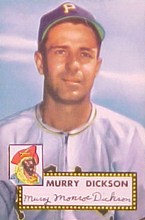
The clubhouse radio was on and Red Barber and Vince Scully, who were doing the Dodger broadcast, went over the starting lineups. I began to undress and noticed the only player remaining in the clubhouse was pitcher Murry Dickson (1916-1989), who was then in the twelfth year of a twenty-year major league career. He had tasted champagne with the St. Louis Cardinal Championship teams in the 1940s and won 20 games in 1951 on a Pirates’ team that won only 64 games. He was the only truly qualified major league pitcher on the 1952 Pirates’ team that lost a record 112 games. I had been a huge Cardinal fan as a kid, and to be in the same clubhouse with Murry Dickson was a treasured moment.
Dickson was listening to the broadcast in the fist inning, with two out and Frank Thomas at bat for the Pirates. Thomas hit a low line drive to center field, which Frank thought Duke Snider had caught on the fly, but actually was trapped by Snider. I still recall the description of the play by Red Barber: “Thomas’ line drive was trapped by Snider in center field and he relays it quickly to Jackie Robinson at second base.” Excitedly, Barber continued, “Now Thomas is heading into center field and Robinson is chasing him, and tags him for the final out in shallow center field.”
Dickson, who had seen a lot of ugly baseball that season, said “They ought to send some of these guys so far into the minor leagues that even 'The Sporting News' couldn't reach them.”
(Image from Gary Bedingfield's website, Baseball in Wartime http://www.baseballinwartime.com)
Another great review of Nellie's book, this time by John Mehno of Western Pennsylvania's Beaver County Times:
Nellie King has written a book, “Happiness Is Like a Cur Dog,” and it would be perfect for any baseball fan on your Santa list.
The book sells for $10.70 in soft cover and $15.40 in hardback at (www.authorhouse.com/bookstore), which makes it one of the season’s great bargains.
The subtitle is, “The Thirty Year Journey of a Major League Pitcher and Broadcaster,” but that’s only part of the story.
It’s really the 81-year journey of Nellie King from Shenandoah, Pa., to Pittsburgh sports icon.
His storytelling skills are superb, the writing style is smooth and witty. The people he’s met vividly come to life: Branch Rickey, Roberto Clemente, Bob Prince, and even the managers at KDKA who swept King out of the Pirates radio booth in 1975 because of their personal vendetta against Bob Prince.
King’s baseball career started in a time when players took two-day train trips to their minor-league outpost and wore triple-digit numbers in spring training because there were so many hopefuls.
After his major-league career was derailed by an arm injury, King endured a couple of unsatisfying non-sports jobs, then fell into broadcasting in Greensburg.
He got a spot on the Pirates broadcast team in 1967, and was Prince’s sole partner from 1971-75. His easy style and player’s perspective were the perfect counterpoint to Prince’s fan-based bombast.
When that ended without warning, King found a new purpose in the Duquesne University athletic department.
A lot of people try to tell stories and wind up saying, “Aw, you had to be there.” That never happens with King. The reader feels like he is there.
Recent years have presented King with a number of major health challenges, including cancer, heart surgery, Parkinson’s disease and a near fatal case of pneumonia in 2007. But back every time, kept an amazingly positive perspective, and wrote a great book.
Nellie King, 0-for-23 as a major-league hitter, has hit a home run as an author.
You can hear Nellie's interview on ESPN 1250, hosted by Guy Junker, Stan Savran, and Chris Mack, which aired on November 24, 2009. Happiness is Like a Cur Dog is now available for sale on book shelves at Barnes and Nobles stores in Pittsburgh. Happy Thanksgiving to everyone!
As a result of the "Olbermann bump," the book now ranks among the top 50 titles on Amazon.com's list of "autobiographies of the rich and famous." (Though Nellie is quick to note he was never rich, since he played the game in the B.C. era of baseball--"Before Cash!")
Nellie and the family now add, to their list of many things for which to be grateful this coming Thanksgiving Day, the kindness of Mr. Keith Olbermann, a true-blue fan of baseball!
In honor of tonight's first game of the 2009 World Series championship, Nellie recalls a series that the Yankees lost, in the last inning of the last game. Nellie's book is now on sale, and would make a great holiday gift for Pirate fans and baseball aficionados everywhere.
Enjoy this excerpt:
...The 1960 Pirates were a group of experienced, mentally tough, hungry, happy, at times crazy, but always-confident players who felt they owned the final three innings of every game. To the fans and the media, they were the “Battling Bucs.”
Benny Benack’s Dixieland Band created a loose and fun-filled atmosphere at Forbes Field that summer with a theme song written by an advertising agency for Iron City Beer, which had everyone singing, “The Bucs Are Going All the Way, All the Way this Year!” Little did the fans realize that the team’s trademark of coming from behind to miraculously win games would continue all the way to the final inning of the last game of the World Series.
The series was supposed to be a mismatch between the favored New York Yankees and the underestimated Pirates. It was, when you added the total runs scored that the Bucs won all the close games. Prior to the Series, I interviewed a few Pirates’ players, asking whom they thought would be the star of the Series. Groat, Face, Law, Hoak, Clemente, and Virdon were often mentioned. Harvey Haddix, whom I had played baseball with in the Army, was the only player to pick Bill Mazeroski. I asked him why, and with the wisdom of a veteran pitcher he said, “Because the Yankees will pitch to him.”
The Series, which began and ended in Forbes Field, was as dramatic as you could get. The Bucs won the opener 6-4, but were blown out in two straight embarrassing losses, 16-3 and 10-0. Their confidence shaking, the Bucs won the final two in Yankee Stadium with strong pitching from Law, Haddix, and Face, who saved the first three wins.
With the Pirates leading 3-2 in the series, back in Forbes Field for the sixth and, if needed, a seventh game, winning the World Series was now a reality for Pittsburgh fans.
However, Whitey Ford shut out the Bucs 12-0 for the second time, so there would be a seventh game. New York Daily News sportswriter Dick Young best described the situation. His lead line read: “As Mrs. Dionne said to Dr. Dafoe, ‘Don’t go away. There’s more to come’.” (Dr. Dafoe was the name of the doctor who delivered the famed Dionne quintuplets.)
The series now came down to one last game. It was to be the most memorable baseball game ever played in Pittsburgh, and perhaps in World Series, history. Blowing an early 4-0 lead, the Pirates trailed 5-4 following Yogi Berra’s three run homer off ace reliever Elroy Face in the sixth inning. The Yankees appeared to wrap it up with two more homers in the eighth for a 7-4 lead. But there was indeed “more to come.”
Trailing by three, the Pirates’ Gino Cimoli pinch hit for Face and singled to right center. Then the Pirates got a huge break when Virdon’s grounder to Tony Kubek appeared to be a sure double play ball, but the ball took a bad hop on the “alabaster plaster” (as Pirates’ announcer Bob Prince described the rock hard infield at Forbes Field), hitting Kubek in the throat and putting two on and no outs. The blow forced Kubek to leave the game and Joe DeMaestri replaced him at shortstop.
With nobody out, Groat gave one of many of his clutch hits, with a single to drive in Cimoli. Jim Coates replaced Bobby Shantz, who had earlier pitched four scoreless innings. With runners at first and second, Bob Skinner moved Virdon and Groat to third and second with a perfect sacrifice, but Rocky Nelson’s fly ball to right did not allow Virdon to score. With two out and a 7-5 lead, Coates would make the blunder that set the scene for the most exciting finish of a deciding game in the history of the World Series.
Roberto Clemente came to bat and tapped a slow roller down the first base line, which should have been the final out of the inning, but Coates was late covering at first and Clemente, hustling as he always did, was safe. Virdon scored, to cut the Yankees’ lead to one run at 7-6. Hal Smith, who replaced Burgess (who left for a pinch runner in the seventh) hit what then appeared to be the series-winning hit. With the count of 2-2, Smith hit a three run homer to left center that gave the Bucs a 9-7 lead going into the ninth.
Bob Friend, who rarely relieved, was called on to finish the game. Bobby Richardson and pinch hitter Dale Long opened the Yankees’ ninth with singles to put the tying runs on base. With the Yankees’ left-handed power hitters—Maris, Mantle, and Berra—coming up, Murtaugh had no choice but to go with left-handed pitcher Harvey Haddix. Harvey retired Maris on a foul out, but Mantle singled, scoring Richardson to make it 9-8 as Dale Long, the tying run, went to third just ahead of the throw by Clemente with only one out.
Casey Stengel, who had erred in allowing Long to stay in the game, finally realized he needed speed, and Gil McDougald was inserted to pinch run for Long at third base.
In one of the most unusual plays, Berra hit a line drive to Rocky Nelson, who was holding Mantle on at first base. Nelson trapped the ball, tagged first, which took off the force play at second. As Nelson went to throw to second, Mantle, who probably thought the ball was caught on the fly, or made one of the most intelligent running decisions in series history, (I firmly believe it was the former) slid back into first base ahead of Nelson’s tag, as McDougald scored the tying run. I vividly recall watching catcher Hal Smith after this play. His head and shoulders dropped in disbelief. The game was now tied and his three-run homer was just a footnote in the box score. Haddix then retired Bill Skowron to bounce out to end the inning.
Viewing the game from one of the booths overhanging the first base side at Forbes Field, I recall how eerily silent it was, similar to a wake, as the Pirates came to bat in the bottom of the ninth. Bill Mazeroski stepped in to face Ralph Terry, the fifth New York pitcher of the game.
The rest is history. Maz hit what many believe remains the most dramatic home run in baseball history to beat the Yankees 10-9 and capture the 1960 World Series Championship.
How Mazeroski felt during those historic moments remained untold until some forty years later. It came not during a sports interview, but during a post-dinner question and answer session at a Pirates Alumni golf outing at South Hills Country Club in the summer of 2001. An audience member asked Maz to “Walk us through what was going on in your mind at that time.” Maz, in his humble “aw shucks” way, preferred not to respond until everyone, players included, pleaded with him to do so.
Roy McHugh, a prominent sports writer for the Pittsburgh Press in 1960, had witnessed Maz’s home run, and when I told him later about the question asked by a fan at the dinner he remarked, “What a great question! Nobody thought to ask Maz that question before.”
As best as I can recall, this is how Maz described that unforgettable event:
“As a kid living in Rayland, Ohio, I was a big Cleveland Indians fan and hated the Yankees. I remember thinking as we took the field in the top of the ninth inning with a two run lead, ‘here we are, needing only three outs to beat the Yankees to win the World Series.’ However, when the inning began to fall apart and they tied the game I started to think, ‘The damn Yankees always seem to win the big games!’ After the inning ended in a tie, I sat dejected in the Pirates’ dugout, feeling the disappointment of losing the lead, until I heard a coach holler, ‘Maz, grab a bat, you’re the lead off batter in the inning.’
“I had completely forgotten I was the batter to open the bottom of the ninth inning.”
Maz continued his vivid recollection of that moment,
“All I was thinking of was getting a good ball to hit and to hit it hard. The first pitch from Terry was a high fastball that I took for a ball. I remember hearing Johnny Blanchard, who took over the catching duties when Berra moved to left field, holler to Terry, ‘Keep the ball down on this guy. He’s a good high ball hitter!’ The next pitch was another high fastball, but in the strike zone. I knew I hit it good and ran hard, knowing it could be a double and possibly a triple as Berra was going to have trouble fielding the carom off the left center field wall.
"As I approached second base, I noticed the third base umpire raise his hands signaling a home run. That’s when I began celebrating, waving my hat, knowing we had actually beat the Yankees. From the time I reached second base and saw the umpire signal home run, until I touched home plate, my feet never touched the ground.”
The crowd at Forbes Field, along with people working downtown and everywhere in western Pennsylvania, began a spontaneous and amazingly peaceful revelry. To this day, Pirates’ fans who took part in the celebration can tell you where they were and what they were doing when “Maz” hit that home run. Only a year ago a fan told me he was driving on Smithfield Street near Kaufmann’s department store, listening to the game on radio when “Maz” hit the home run. He jumped out of the car, left the motor running, went into a bar across the street and joined in the festivities. Soon the people in the bar moved out into the street with their drinks, joining in the bigger celebration outside. Confetti was now pouring from office buildings downtown; people were driving with their lights on, yelling, and honking their horns.
I was lucky to witness the Pirates’ clubhouse celebration. Players sprayed champagne all over the room as they shared hugs with each other. Bob Skinner and Bill Virdon each grabbed a bottle of champagne and shrewdly hid them in their lockers. ….

Being tall and thin (6’6”, 180 lbs.) always made me a target for the usual comments — “Don’t drink any cherry soda, you’ll look like a thermometer by the fourth inning!” The most original remark I heard in my eleven seasons of baseball occurred in Macon, Georgia, in 1950. Half a century later, I still can still hear the comment and see the hitter who uttered the remark.